Should transgender athletes compete in women’s MMA: The data
There has been far more heat than light surrounding the current controversy over whether a transgender (male to female) fighter should be allowed to compete in mixed martial arts in the women’s division.
This article on The Verge said that opponents of Ms. Fox competition “are not supported by the current science”, citing the fact that the International Olympic Committee allows transgender athletes to compete under certain conditions – set number of years post-surgery, hormonal therapy.
Since mixed martial arts is not an Olympic sport whatever science on which this decision was based most likely did not include any studies involving mixed martial arts. I say most likely because although I asked on my other (personal blog), where I write about sports a lot for citations of this supposedly voluminous scientific literature no one provided me any relevant references and I did not uncover any searching the National Library of Medicine database. A few people did send me references to articles on hormonal therapy but none of these even discussed the issue of sports participation. Their focus instead was on the possible side effects, e.g. cancer or other ill effects, of people with various hormone regimens.
The most reasoned discussion on this topic I have read is on Dr. Rosi Sexton’s blog, and I agree with her three main points:
- There is not much at all in the way of data documenting whether or not Ms. Fox has an advantage competing in martial arts. Expert opinion is split on this issue.
- No one has a right to compete in mixed martial arts. There are all kinds of qualifications – you have to be a certain weight and gender to compete in a division. You can’t be pregnant.
- Mixed martial arts are different than say, canoeing, because you are trying to do bodily harm to your opponent. Unlike in many sports, a Type I error – rejecting a true null hypothesis – is likely to cause harm to others.
Read her blog. It’s good. Personally, I want to address a couple of other points. On twitter, Shelly Summers made the comment that it was difficult to dispute that Fallon Fox (or any transgender fighter) does not have an advantage unless it is spelled out exactly what her advantage is supposed to be. Now here I’m on firmer ground at least because we can couch this in terms of an equation. Logistic regression would be best, with win or loss as the dependent variable. The question then is what are the independent variables. This might seem a straightforward question but it’s not. Let’s start with what should be obvious.
1. Different sports have different requirements for success. Males don’t seem to have an advantage in equestrian – the sport is mixed gender in the Olympics. We have separate shooting events for men and women, but I don’t know why. Winning the marathon requires more endurance. Winning a gold medal in weight-lifting requires more strength. Women tend to do better in long-distance swimming. Men are better at football. Height is an advantage in some sports (basketball, volleyball) and not in others. I could go on, but you get the point, I hope, which is that you cannot generalize about “sports”.
2. Even in the sports like football, baseball and basketball where millions of dollars are spent on data analysis, the predictions are far from perfect.
3. There are several variables that predict athletic success, including in mixed martial arts.
I know a lot more about judo than mixed martial arts specifically, but there is some overlap, so let’s look at what you certainly need:
- Physical strength. While technique will beat strength, if other things are equal, the match goes to the person with more strength. It’s like using steroids – it doesn’t guarantee you the win, but it gives you an edge. People have argued that the hormonal levels of transgender females are no different than those born female. A more relevant test would be measures of physical strength. Given that two people of the same weight engaged in the same strength and conditioning program would there be a difference in measures of strength like the maximum weight in the bench press, dead lift , the maximum number of repetitions at a given weight, recovery after a given rest period, etc.? I don’t know. It might also be hard to assess this if people knew they were being studied because either person might consciously or subconsciously lift less and affect the results. This is why researchers favor double-blind studies where neither those collecting the data nor those giving it know if they are in the experimental or control group. The only way I see you could do this though, is through deception, e.g., telling both parties you were assessing the effect of a specific hormone regimen. Regardless, as far as I know these type of data are not available from well-controlled (or really, any) studies.
- Endurance. A judo competition is several matches of four minutes each, usually with a rest period of 10- 60 minutes in between. Mixed martial arts matches are either three or five five-minute rounds, with short rests in between. An indirect measure might be something like lung capacity, but a more direct measure would include things like resting heart rate immediately after each round. Physiological measures are not my specialization, but I cannot imagine any way in which direct measures would not be preferable to indirect ones. Again, this is an area where I am not aware of any research, certainly not for MMA specifically.
- Reach. I can guarantee this from having fought for years – and having won a world championships, I fought at a pretty high level – competitors who have a much longer reach have an advantage.
- Psychological factors. If you have watched many combat sports at all, you have seen those matches where someone should not have won and yet they did. This is something every top athlete has, that absolute refusal to lose.
- Speed. If you can beat your opponent to the punch every time (figuratively as well as literally) you will win.
Have there been studies establishing transgender female mixed martial artists and other female mixed martial artists on these characteristics? I’m almost certain not. If we don’t have any evidence that Ms. Fox does NOT have an advantage, it would make sense to agree with Dr. Sexton that it is best to err on the side of the safety of the other women in the division and disallow her competition.
One thing did immediately strike me when I heard about this story that made me say — wait a minute. Fallon Fox is 37 years old. How many professional competitors in women’s mixed martial arts are 37 or older ? I looked up the women’s rankings in the Fight Matrix for the 145 and 135 lb divisions. I added Ms. Fox into the mix, and to be fair, I also added Peggy Morgan, the woman who would have been her opponent in her next bout, except she has announced she refuses to fight Ms. Fox. While MMA Junkie lists Ms. Fox age as 43, other sources list it as 37, so I used the lower age. To give one more data point, I added Marina Shafir who just won her fight tonight and is the same division as Ms. Fox. Since Marina is only 24, I calculated the results with and without her. Still significant.
Here is the age distribution for those 30 women.
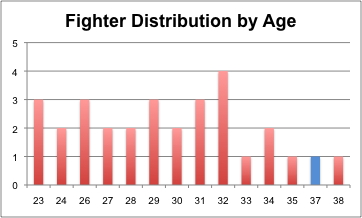
There is exactly one woman older than Fallon Fox among those competitors – Hitomi Akano. Ms. Akano lost her last two fights . ** NOTE CORRECTED ON 3/27/2013 see comment below.
The average age of the other 29 fighters was 29.21. Using a z-test with this as the population value and the population standard deviation of 3.9 gives a z-value of 1.99. If we were conducting a one-tailed test of the hypothesis that Fox is significantly older (based on an assumption that a transgender female would have an advantage and be competitive at a later age) we would reject the null hypothesis as the critical value of a one-tailed test is 1.64. However, if we were to use the more rigorous two-tailed test and say our alternate hypothesis is that being transgender could be an advantage or disadvantage, we’d still accept the null hypothesis as the z-value is greater than 1.96
At most we can say there is slight evidence for an advantage, and that based on a small amount of data.
We can note that in this sample, as Ms. Akano has not won a fight since she was 36, there is exactly one person in here with a winning record after age 36, and that is Ms Fox. There are nine fighters in this sample that have winning record of 100%. The other eight fighters range in age from 24 to 33 with an average age of 28.9 years.
What we can say from this admittedly small sample of data is that Ms. Fox appears to be winning decisively at an age that is significantly older than the average female competitor in or near her weight division. At least as far as the age at which she is successful in competition, Ms. Fox DOES appear to be significantly different than a sample of mixed martial arts fighters who were born female. Could this be because she is more determined, trains harder, wants it more or just has an amazing coaching team? Yes, it could. Could it be because we only have a small sample which could be non-representative of women mixed martial arts fighters? Yes, it could. I’d be happy to do a large, well-controlled study with lots of variables, but it turns out that I have to get back to doing the analyses for which people pay me money.
Anyone else is welcome to find their own data, list their sources and post it or publish it wherever they like. Please give a link in the comments if you do. What I did was use the data that was available to me and actually looked at female mixed martial artists and performance. What I did not do was consider data on hormones, law, a hypothesized set of data that somebody must have had somewhere before making a policy and not someone’s opinion on what people should or should not do in their private lives.
The very questions you ask show your bias. Why is the focus on proving that transgender athletes are equal and/or not dangerous? How could you possibly think that you could prove that an advantage doesn’t exist? Can you prove that anything doesn’t exist?
Why is it that these supposedly well-reasoned and “unbiased” arguments against her first point out the primary concern for the safety of the athletes, then go on to talk about endurance, lung capacity, and her win-loss record? You’re right that not everyone has the “right” to fight and there are established issues that might disqualify a fighter and we have separate weight and gender classes. Is there any criteria for cis gender women for which they would be disqualified because they present a danger to opponents. Pregnancy is a danger to ones self. If a cis gender woman fighter came along that can punch 10% harder would she be disqualified for her natural advantage?
I think every single attribute you list as justification to disqualify trans athletes you need to ask yourself if you would disqualify a cisgender woman for that same natural advantage. You need to ask yourself if you’d be willing to discuss disqualifying black women from one sport or another because of some statistical advantage they may have. You need to ask yourself if you’re really only concerned about safety and stick to only attributes that pertain to safety.
All of these “reasoned” arguments against Fallon Fox are really based on the assumption that trans women are inherently not women. This idea that we should, because of “common sense,” treat trans women with extra scrutiny is disgusting to me. If Fallon Fox passes a physical or whatever other requirements are in place and she still poses a threat to her opponents safety, then you absolutely should re-evaluate how you clear fighters to fight. But saying something like “XX chromosomes required” is lazy, discriminatory, and doesn’t even fix the problem.
A lot of people asked and debated this question before me. My first point was to say that those in the debate who claimed there was a great deal of scientific evidence to document that a transgender woman has no advantage were, as far as I can determine, incorrect, as I could not find any documentation and to date, no one, including you, has pointed to any.
My second point was to say that establishing whether or not an individual has an advantage varies from sport to sport and is not at all a simple question.
I’ve been pregnant four times and I would have to question that pregnancy is a danger to oneself. I got into a heated argument with the Olympic Training Center staff because they did not believe I should train while pregnant. Their concern was not about me about about the baby.
There ARE rules that can disqualify you if you are a danger to your opponents. I have an artificial knee. Before it was replaced, I trained with a knee brace that included metal. When I competed, I could not use it and if I did, I would be disqualified. Yes, I know people who have been disqualified for this exact reason and saying it is a medical necessity made no difference.
If I found a woman was two or three standard deviations above average in any trait listed above, yes, I would immediately want to know why.
I don’t believe I said anything like XX chromosomes required.
Well first lets ignore the fact that some of the arguments argued She has XY cromosomes which makes her a man. The fact is we dont know what her chromosomes are. And there are many many individuals out there who do not have chromosomes that match their birth gender.
The fact is no she should not be allowed in these things. Why? Because you all don’t want her in it. Thats why. It will never matter what the science says. I will admit can find little pointing out either way. But historically it wont matter what the science says when it comes to transgender people. I’ll give you an example. I am accused of being a rapist, or child molester because i use the woman’s restroom. In my state and many others there are laws that allow this. However the fact that there has been no rape, or attacks that were done using the basis of this law, It is still fought every step of the way. We are still attacked or threatened that if we use the restroom someone will hurt us.
The facts are this. She does not have testosterone flowing through her body, Well i lie she does. But its formed in the adrenal glands which btw is where females form their testosterone. So that’s gonna be the same. Secondly in this athletes case she did not start training until after GRS and HRT which makes it less likely that she has more muscle mass than any other girl out there because she was training under the same female conditions. The only argument to why should should not fight that I have heard that i cant really attest to is that her bones are denser. But is that really a reason to stop someone from fighting? If so we should stop every runner, every weight lifter from fighting. Or better yet have a required amount of weight that they can use and no more. As well as regulate their running. The fact is that weight bearing exercise can very well increase the density of bone. It is a treatment we use to help those with osteoporosis.
If we don’t want transgender people like myself fighting in sports lets at least be honest about it. It isn’t because of a perceived advantage we have. Its because we are perceived as the other gender and therefore unworthy and undeserving of being part of your society. It isn’t about science or advantage. Female fighting is a female sorority and for a man or someone who is perceived as a man to infiltrate it seems to invalidate the group. This is the same reason some feminists are against transgender rights.
Jennifer,
I’m going to give you some advice someone gave me years ago and it proved helpful to me. Just because you believe something passionately does not make it true. If it is in fact true that transgender people have no advantage then I am perfectly fine with them fighting in whatever division they want. If they do have an advantage then it is not fair. We don’t let women who are over 150 pounds fight in the 145 pound division. At local judo tournaments where a person in the open weight division is substantially over the weight of the next smaller person, we don’t let them compete and it isn’t because we hate heavy people.
What I tried to point out is the difficulty of establishing whether someone has an advantage and the scarcity of evidence in doing so.
You, Ms. Fox, believe her right to compete and be treated equally supersedes any safety or fairness concerns to her competition. I disagree. It’s not because I hate you or frankly, have any interest in a person I have never met. I have worked with a couple of people who were transgender and it was a non-issue .
My first experience with transgender came in high school. A girl in my class said she always wanted to be a boy. She said she thought I would understand since I was so into sports and math and boy type things (remember, I was 15 a long time ago). I didn’t get it and I said sure, everybody would like not to be discriminated against and boys had an uneven advantage, but no, she didn’t really want to be a boy. She insisted she did. A few days later, concerned, she came to me and said she didn’t want me to tell anyone and she didn’t want me to think different about her because she wanted to be a boy.
I was very puzzled by this at the time and I asked her why would *I* care if *she* wanted to be a boy? It didn’t seem like anything to be concerned about then or now.
If you want to use the bathroom, teach at a school or dance at a wedding, go for it.
However, it has been said that your freedom to move your fist stops at my face, and this is a case that applies literally.
I really, really wanted to be an astronaut when I was young (seriously). I’m good at math and science, too. I learned early on that my eyesight disqualified me. I was disappointed but I moved on. Sometimes physical attributes just disqualify us and it is nothing personal.
“There is exactly one woman older than Fallon Fox among those competitors – Hitomi Akano. Ms. Akano lost her last three fights (although the fight against Santos was ruled no contest due to her opponent failing a steroid test).”
This is incorrect.
Hitomi Akano only lost 2 of her last 3 fights and won 1.
Akano’s fight against Cris ‘Cyborg’ Santos (not among her last 3 fights btw) was not ruled a NC. Cyborg did not test positive for that fight.
It seems you’re confusing Akano with Hiroko Yamanaka.
Yamanaka did lose all of her last 3 fights, (with the one against Cyborg later being declared a NC due to Cyborg testing positive).
Unfortunately this is not just a simple name switch, since you still used AKANO’s age. (Yamanaka is 34 and therefor not older than Fallon Fox).
Lea,
Thank you for the correction, I stand corrected and noted the correction above. The name was Hitomi Akano and you are right, I did have her confused with the person in the NC against Santos. I DID use the correct age. Both Akano and Yamanaka are included in the chart. Akano DID lose her last two matches and has NOT won a match since she was 36. The last match she won as in July, 2011 shortly before her 37th birthday – at least per wikipedia.
Leah, you’re full of poop. YES, born women face standards they must meet, too. If a ‘cis’ woman as you say had, for example, abnormally high levels of testosterone for a woman she wouldn’t get to compete either.
Your analysis is baffling. You’re trying to prove that transgenders have an advantage because they can fight at an older age? Just bizarre…
Fox has had two fights her whole career. How can you compare that to Akano, who’s had 28? Akano lost her last two fights but they were both against top 5 fighters in the division. Neither of Fox’s opponents had won a professional fight! The women in your chart are the best fighters in the world, Fox is nowhere near their level (yet).
Also, there’s a difference between age and mileage. Anyway, you should delete that whole section, it’s embarrassing. Sorry if I’m being harsh, but bad data is worse than no data.
I was rude in my last message. I apologize for that. I’m not great at internet discussions…
Suppose Fox takes some physical strength, endurance and speed tests and falls within a normal female range. Is that enough to say Fox can compete, or would you want more tests to be done? (Of course many fighters are exceptional athletes and would score well out of the normal range. What if Fox performed closer to them? Where do you draw the line?)
My impression is that a lot of people arguing against Fox competing would keep moving the goalposts. “Okay, she doesn’t have as much testosterone as men, or women!, but…” “Okay, she didn’t start training until post-surgery, but…” There’s always more reasons to oppose her, more tests that she needs to pass before she can compete. And if that’s the case then they should be upfront about it, that’s there’s nothing Fox could do to convince them she should be able to fight.
Billy –
I cannot comment on other people. What I can say is that there were a lot of commenters saying that vast amounts of scientific data exist supporting that there is no difference between transgender athletes and others. I said that I could find no such published data. You are absolutely correct that the data that I could find is sparse and limited in generalization. It was the data easily accessible to me and I was very upfront about the source of my data.
How data specifically on MMA fighters (albeit experienced ones) is not applicable but data that is “out there somewhere” is, baffles me. Many people have told me “I have studies” or “studies have shown” but the only citation anyone ever provided me was on a study questioning the possible health impact of post-operative transsexuals (their term) taking high levels of hormones. Not exactly relevant.
I have not done a study on this – my point is that no one has – but I did attend a number of amateur events when my daughter was competing in those tournaments and no one competing at the amateur ranks was in their late thirties either, which is why the first thing that made me go “Hey, wait a minute …: was when I heard Fallon Fox was 37. I have to run to a meeting (story of my life), but you are free to come up with your own data set of women who are competing in the amateur ranks and show your sources. I’d be interested to read your results. Honestly, I would.
I agree that Fox is unusually old, but I don’t see how that’s relevant. You seem to be arguing that she’s at an advantage because she’s old. So if instead she were in her 20’s then she’d have less of an advantage? It makes no sense to me.
No, I am arguing that the fact when someone appears to be competitive far past the typical age, it is reasonable to ask whether that person may have some type of advantage – in the men’s division, that is often taking some type of performance enhancing drug that is suspected. In this case, it leads to the speculation whether being transgender might be the explanation
But before we speculate on whether being transgender might be the explanation, shouldn’t we figure out whether being transgender is an advantage or not?
I mean, that’s the whole point, right? We know that steroids are performance enhancing, but we don’t know that about being transgender. Maybe having the same first and last initial is performance enhancing? There’s four of them (including Ronda Rousey) among the thirty fighters in your chart. That’s 4/30 = 0.13, a lot higher than 1/26 = 0.04. Perhaps this is why Fallon Fox is competitive. Can you do a z-test to see if this advantage is statistically significant?
The other thing that’s bugging me is that you aren’t looking for other explanations for her competitiveness. You give one option a passing mention: “Could this be because she is more determined, trains harder, wants it more or just has an amazing coaching team?” But what about the ones I offered?
For example, do you honestly believe that Fox is better than Akano? If not, then isn’t it highly misleading to point out that Akano has a 0% record after age 36 while Fox has a 100% record after age 36? Their win-loss record by itself says very little about how “competitive” a fighter is. (Do you think a 10-0 high school team has a chance of beating a 0-10 professional team?)
You focus on Fox’s age, but maybe what’s more relevant is the difference in ages. Fox’s opponents are 30 and 33, which means a 7 and 4 year age difference. Guess how many of the thirteen fights on tonight’s Invicta card are between two women with at least a 7 year age difference? Six of them! So in this respect Fox’s fights haven’t been unusual. The two oldest fighters are Mollie Estes at 37 with two professional fights and Miriam Nakamoto at 36 with one professional fight. Do you suspect either of them of using drugs (or being transgender)?
I just think that was a guy rejected by males for seeming too feminine and and rejected by females for being a creep and after having her surgery which I do support btw found a way to take her anger out on the world. she could only take it out physically on females so she began training mma. I think that mma and other combat sports should begin taking psychological evaluations of all people who enter them and determine from these if someone is fit to compete in a safe method
AnnMaria, I appreciate your arguments and the rationale behind those arguments. The fact that the verdict isn’t in yet at least in terms of the science, is the key thing.
I know I wouldn’t want my daughter to get in a cage wearing 4 oz. gloves and battle it out with someone who may be unfairly advantaged by the fact that she was formerly a man. MMA is a brutal sport. People who engage in it often become debilitated. It’s dangerous enough when they are fighting on a level playing field, at least gender-wise.
Let’s get the data before we agree that this is okay. And if in the course of the study, more questions reveal themselves that need to be answered, then so be it. The health and even the lives of vital young women are at stake.
I did a little research as to how many other women who were formerly men are participating in combat sports. There is one. Her name is Parinya Charoenphol. Although her fighting name is Noon Toom. I invite any of you reading this to Google her.
Before her reassignment surgery, she was a national kickboxing champion in Thailand. After the surgery and associated treatments, she started fighting again. Now of course she is a woman, but she only fights male kickboxers, and she wins. The Thai’s love her, and respect her. Of course she is a much different breed of person then this Fallon Fox character.
That Fox fought and beat hell out of women without telling them that she had formerly been a man is outrageous. Her opponents had a right to know. They had a right to do their own research. It’s their lives and health that are at stake.
No, Fallon Fox is no Noon Toom. Of course Ms. Toom not only told people what she was doing, but she also restricts herself to only fighting men. She’s not sneaky like Ms. Fox.
I’ve always been a supporter of equal rights for LGBT people. But this issue isn’t about rights or equality. Frankly, in view of the research I have done thus far, I’m considering the possibility that first and foremost, this is a criminal matter. It may well be that Fallon Fox, at the least, should be charged with assault and fraud.
Hang in there AnnMaria. Don’t let these lightweights get you down. You’re kicking butt and helping protect women who until the facts are in, one way or the other, need our protection, our advocacy. We need to speak up for them. Yes, even protect them from the influence of some of the bewildered and confused people in this very forum, who think that by supporting Fox, they are promoting civil rights. That is total nonsense.
It is dismaying to see how shallow and unseeing so many of these mutton heads are. It’s no wonder we get such awful leaders these days. Unfortunately, I suspect, as a society, we get what we deserve. AnnMaria in support of what I’m saying, I offer those who would argue with you, when the right thing is so clear, as undeniable proof.
“Now of course she is a woman, but she only fights male kickboxers, and she wins.”
This isn’t true. As far as I can tell, her last two fights were against women: A clear decision loss to Jorina Baars on 10/15/2007 and a split decision win over Pernilla Johansson on 5/31/2008.
I am SO glad that I am not THE Lea Nash that wrote the comments above…..She seems to have been “chewed up and spit out ” by someone else below her comments……..Good luck LEA…you have a lovely name ……. :>}
I dunno why they just don’t make it male and female instead of men and women. No male can ever become a female and vice versa, anyone can change their gender. This would fix this ridiculous issue